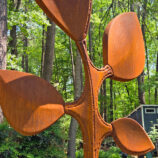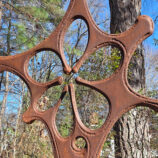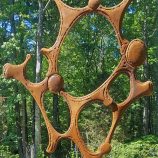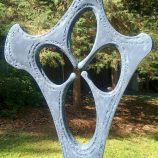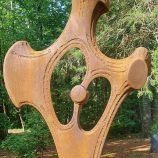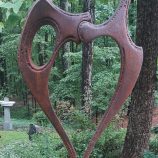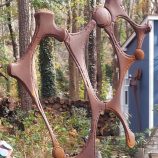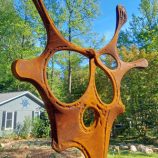
The gently rolling hills at the edge of the prairie where I grew up are composed of the blackest of soils, fertile and unforgiving. It's hard to underestimate the impact this landscape has had upon me. That darkness is my foundation. Here, death is cultivated as readily as new life. Each spring, like clockwork, the darkness awakens and brings forth the lush green of fertile fields and forests. Each fall, the green fades and turns to rust, lying dormant once again.
It took a long time for me to realize the influence of this place. I see now that I attempt to evoke the same immediacy as well as inevitability in my work. And I realize that the conflict I experience here is the anxiety one feels upon burrowing deeper into a place - and into oneself. It is a conflict that you cannot describe as true, because it simply is. Like the crushing cold of a winter wind, it cannot be denied, it can only be endured. That it has become easier to endure, and possibly even ignore, due to modern conveniences does not deny this reality. That the international art community largely ignores this connection does not diminish its presence either. The rootless, disinterested chic of the Coasts is only a mirage here. It is a shimmer on the surface of a magazine cover - fleeting, tempting, and insubstantial - because I know that under my feet is a black void that can swallow me whole, as well as bring me to bloom, if I open myself up to it.
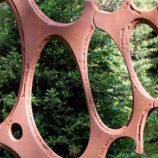
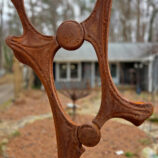
So I cultivate my sculptures like a careful farmer, invoking the forms of nature because they are my kin. I employ the industrial fabrication skills I learned from my father to impart to them a reality beyond my limited understanding. To do this requires not only consideration but craft as well. True craftsmanship is not empty flourish but a way of understanding, the type of understanding that can only come through experience and careful attention. Hands have their own intelligence, and the memory of their labor is vital to the character of the final piece. This awareness is even present in something as fundamental as the materials I choose. I use weathering steel because you can't fight entropy. Instead, I seek to direct it. By using the rust that is inevitable, I create something which speaks for generations.
The most beautiful and evocative sound in nature, for me, is the call of a single crow on a still winter's morning. At that most desolate hour comes a most poignant song, a lamentation and joyful cry at the same time. Beyond words, beyond justifications, beyond knowledge, the song simply is.
I can think of no better model for what a sculpture should be.
As a young boy, I made a wonderful discovery. While walking through the woods of rural Minnesota, I found the skeleton of a boar, weathered and whitened by the sun. At the top of a small rise, in a ring of brambles, there it was. What made me dig my way through the thistles and barbs, I'll never know. But I marveled at what I had found, carefully collecting the vertebrae, ribs, skull, and appendages in a cardboard box. I did not see them as macabre or frightening. To me, they were beautiful jewels - natural, physical memories of what once was. I treasured that skeleton, storing it away until the frequent urge came to pull the bones out for careful inspection.
Perhaps about that same time, I first heard rumors of religious artifacts carefully hidden in the Catholic Church I attended at my parochial school. In my daydreams during morning mass, I would imagine fingers and femurs pulled from corpses of centuries-old saints locked up in secret chambers in the walls. In my mind's eye I saw the bones stained dark, charred and cartilage-encrusted. Never weathered white jewels, they were the memory of the brutality and meanness of man, not unlike the ever-present crucifix on the wall. This was not the transcendent, uplifting, and ingratiating modern Christ; this was a tortured human being, nailed up by his fellow man. Likewise, I envisioned those hidden artifacts as carrying the pungent stench of death and oppression; they were definitely not the sublime revelation of life's mystery and beauty that the boar's remains were to me.
I think of these new sculptures as a bridge between those two opposing, but ever-present, artifacts of my youth. The series is entitled Reliquiae, Latin for "sacred relics." They are mediations on how we as humans, also animals of Nature, honor and dishonor life and death. They are reminders that beauty and brutality can be found in unexpected places. Finally, they are physical symbols of our stumbling attempts at transcendence in spite of instability, transience, and contradiction.
Note: This article first appeared on mnartists.org
Growing up in rural Minnesota, I experienced, however remotely, the early break in human nature: what happened when hunters and gatherers settled down to farm the earth. To this day, the shift seems to permeate the very ground. These two orientations toward life are often thought to be similar, but they are, in fact, radically different. They pull at each other. One impulse contradicts the other. One integrates itself into and becomes a part of nature. The other seeks to alter and control nature, rising above the given and using nature's resources in novel ways.
So it happened that the hunter gave way to the farmer. The Paleolithic became the Neolithic. The peripatetic settled down and took root. Though now we may travel and move with relative frequency, we remain attached to a place on a day-to-day basis. Seasons pass and still we remain, divorcing ourselves from them. But the primal urge to engage nature, to integrate oneself with nature, is a basic force not so simply erased.
Through my sculpture, I discovered that this conflict had become a part of me. Perhaps the battle had existed long before I was born. Each time I wandered through a field, walking along furrows cut into the earth, I wasn't walking alone. Every time I cut a path through the woods or traced the routes of rabbits, I wasn't scouting alone. I was living out a conflict millenniums old, and it still felt undecided.
The hunter is a keen observer of life, a participant and a wanderer. In order to capture the animal, he must think like the animal. The hunter does not sit on top of Nature; he is simply one aspect of it. He does not dominate, he participates. And when he has taken his prey, he gives thanks to that beast for giving its life up for his own. The animal itself is a god. And man, because he too is an animal, is also a god.
The farmer is a rationalizer of nature, a creator of his world. He divides the land and cultivates it. In his hands, it becomes something different than it was. Remaining in one place, he re-creates Nature according to his image. To make his harvest dependable, he simplifies and alters. He breeds new types of grain, new types of animals. He too is a god, but a god of his own making. He captures the world, and the fences he erects in turn capture him.
As parts of the human race make the transition into a future cyber-reality, this conflict may seem primitive and irrelevant. But perhaps it is a special quality of Americans to believe that we can re-invent ourselves; that evolutions that once took thousands of years can today be accomplished in a generation. But of course this is not the case. As we enter the 21st century, we are in fact nearly identical to humans of a thousand years ago. In that case, such a "primitive" conflict as I experienced growing up, and since then in my work, is relevant.
For a long time, I could not explain the different strains in my sculptures. The works I create can be broken down into a few radically different types, seemingly unrelated to one another. One part of me creates oversized steel flower-like traps and bone forms that could be relics of animals long extinct. As a child, I would spend my time in the woods playing at setting rusty leg traps to catch rabbits. I was never successful at it.
The forest contained many treasures, but I did not have the skills to unlock them. In my juvenile enthusiasm, I could do little more than damage everything I touched. Looking at the sculpture American Lotus, I see that impotence and danger made physical. Like those woods, the sculpture is beautiful in its complexity and design. It undoubtedly has a purpose, and the viewer seeks to inspect it closer to unlock the mystery. But only when it is too late will you understand that you had no right going so close.
Another part of me creates geometric and organic fusions: sculptures that invoke seed forms and otherworldly growths. Picking rock or just traversing the uneven terrain of the plowed fields, it is amazing what you can find. Agates, glacially worn round rocks, broken bones, are just a few of the durable forms the ground throws up. In Fractured Daemon, I see a flower that has sprouted from such disparate "seeds" and taken root in the black earth. Here, I am a farmer myself, but the work is rooted in an imaginary distant past. Corn and wheat don't interest me, but what if those rocks, bones, and fossils could be planted? What could they become?
At other times, hybrid, transitional forms emerge as if distinctions had become fluid and are no longer operable; differences break down and the walls between opposites crumble. In Regret, a geometric dodecahedron begins like a seed, splitting and replicating as it grows. But as the form rises, it solidifies into a single, pierced stalk. From there, a massive chain continues that replication in its links until finally a primitive, violent hook stands ready. Is it prepared to kill or simply to anchor? In these moments, my work seems to attempt an abstract, uneasy fusion of this primal conflict.
Looking over what I've created, I begin to understand that no single approach is sufficient. Though I may try, I simply cannot limit myself to a single style because I believe these conflicts are increasingly relevant as we move forward. The world we live in and the world we've left behind continue to inform our every action. These contradictory forms are needed to make palpable the space that lies between them. Only in the presence of all three can I feel the conflict inherent in the land made physical.
In the corner of nearly every field can be found a rock pile. Fields tend to be rectangular in shape so when a tractor makes a round, it leaves the very corners untouched. Stones picked from the freshly tilled earth are deposited there. Over time, a mound begins to develop, tall grasses grow freely and small brush begins to sprout. Tunnels open up under the settling pile, housing rabbits and fox among others. The seasons pass, new generations are born and die, yet this pile of stone grows. If the field lies fallow, the rock pile is patient. The bones of small animals lie bleached in the sun. Rodents gnaw on them for calcium. The small furrows cut into the bone mimic the rows carved into the field. A memory of everything that happens on the land can be found there.
Climbing around these rockpiles as a child, I never knew what I would find. Then I left, only to return. Before I realized it, these markers had grown into my work. I began creating sculptures of fieldstone and mysterious, bone-like fragments held up over the land on a weathered, wood post. I called them Cairns, which I knew from elsewhere to be a memorial of stacked stones. Not realizing until now that a memorial is not something formal and distant, but something that grows naturally from the earth and human hands. My work has re-introduced me to a landscape that was never truly absent.